Pressure is not the whole answer
Two systems at the same gauge pressure can move different amounts of air and create different charge temperatures. Compressor efficiency, engine airflow, altitude, and restrictions determine the actual result.
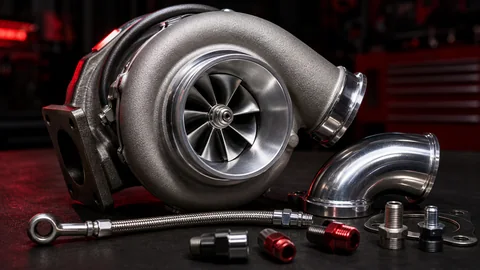
Learn how turbochargers, Roots and twin-screw superchargers, centrifugal superchargers, and ProCharger systems work—then compare the parts, mounting choices, controls, supporting systems, and trade-offs that determine whether a build is responsive, powerful, reliable, and enjoyable.
An engine makes power by trapping oxygen, adding the correct amount of fuel, and burning that mixture at the right time. Forced induction increases the mass of air entering the cylinders. More oxygen can support more fuel and therefore more torque—but cylinder pressure, heat, fuel delivery, tuning, and mechanical limits rise with it.
Two systems at the same gauge pressure can move different amounts of air and create different charge temperatures. Compressor efficiency, engine airflow, altitude, and restrictions determine the actual result.
Boost threshold describes when the engine can make useful boost. Lag is the response delay after a torque request while operating in that usable region. Sizing, gearing, manifold volume, control strategy, and engine load affect both.
Correct fuel pressure, injector control, ignition timing, knock strategy, charge temperature compensation, boost limits, and sensor data matter as much as the compressor itself.
Use this page as a route map. Choose a goal below, then open the focused lessons for labelled diagrams, comparison tables, calculators, buying checks, and technical sources.
Understand the airflow path, compare system types, then learn the valves and charge-cooling hardware that protect the compressor system.
Turn power, response, packaging, fuel, and use-case requirements into a complete parts and installation plan.
Start with the symptom, stop unsafe testing, verify control and oiling basics, then collect pressure, temperature, and ECU evidence.
Follow the full air and exhaust path, name every major component, and understand boost threshold, lag, A/R, bearings, and wheel terminology.
Open lesson → Lesson 2 · Calculator includedEstimate airflow and pressure ratio, read surge/efficiency/choke/speed boundaries, match the turbine, and build a defensible shortlist.
Open sizing guide → Lesson 3 · ArchitecturesCompare fixed geometry, VGT/VTG, open and divided housings, single, parallel twin, sequential, compound, and electric-assist systems.
Compare technologies → Lesson 4 · InstallationCompare top, front, low, mid, rear, and hot-V positions, then design oil return, scavenge, support, shielding, movement, and service access.
Plan the installation → Lesson 5 · Instant torqueCompare how the two positive-displacement families compress air, then check pulley speed, bypass control, belt load, charge cooling, and torque limits.
Open supercharger guide → Lesson 6 · Head-speed calculatorUnderstand progressive boost, step-up drives, impeller speed, belt systems, bypass valves, intercooling, and how this category differs from turbo and Roots systems.
Open centrifugal guide → Lesson 7 · Valve selectorChoose atmospheric, recirculation, dual-port, diverter, or bypass routing by compressor flow, metering strategy, response, flange, and control—not sound alone.
Choose a valve type → Lesson 8 · Boost controlCompare internal, external, and electronic gates; choose safe spring pressure; route references; and diagnose creep, spike, oscillation, and low boost.
Open control guide → Lesson 9 · Pipe-area calculatorCompare air-to-air and air-to-water cooling, pressure drop, ducting, heat recovery, pipe diameter, bends, couplers, brackets, sensors, and condensation.
Plan the cold side → Lesson 10 · Diagnostic assistantWork through slow spool, creep, spike, surge, smoke, high IAT, blown charge pipes, unstable idle, and supercharger belt slip in a safe order.
Diagnose a symptom →Match compressor and turbine housings, wheels, shafts, backplates, bearings, CHRAs, oiling, cooling, rotation, and balance requirements by evidence—not appearance.
Check component compatibility →These links open the matching product group directly. Confirm vehicle fitment, exact part numbers, system compatibility, installation requirements, and calibration before purchase.
Browse by bearing, flange, scroll, wheel construction, technology, application, and frame size.
Lesson 11 matchHousings, CHRAs, wheels, bearings, thrust parts, seals, clamps, fittings, and rebuild hardware.
Hot sideCompare construction, position, scroll pairing, flange, wastegate layout, material, and application.
Exhaust controlInternal, external, electronic, pneumatic, vehicle-specific, and application-focused control hardware.
Boost strategyManual, electronic, open-loop, closed-loop, staged, dome-pressure, and ECU-compatible options.
Compressor protectionChoose by metering strategy, recirculation path, control method, flange, and verified flow capacity.
Charge coolingAir-to-air, air-to-water, location, construction, core, ducting, and installation choices.
Cold sidePipes, couplers, clamps, reducers, fabrication pieces, sensor provisions, and support hardware.
CHRA supportFeed, drain, coolant, restrictor, fitting, heat-protection, and scavenge-system hardware.
Crank-driven systemsCases, rotors, drives, bypass hardware, brackets, pulleys, belts, cooling, and service components.
These tools narrow the correct category and questions to ask. They do not select a final model, pulley, boost level, or calibration without vehicle-specific measurements.
Choose your priorities to compare turbo, positive-displacement, and centrifugal-supercharger paths.
Choose how the engine measures air before deciding how much sound you want.
These examples show how the goal changes the system. They are planning templates, not universal shopping lists or promises of a specific power number.
Most failures are system failures: the main unit receives the blame, but the real cause is often oiling, fuel, heat, control, installation, or expectations.
A unit can technically support the target but operate poorly over the rpm range the vehicle actually uses.
Pressure without airflow, temperature, fuel, timing, and engine efficiency does not define torque or safety.
A compressor may look ideal while the turbine restricts the engine, increases residual exhaust, and adds heat.
Small, uphill, submerged, kinked, or pressurized returns can cause leakage and smoke even when the turbo is healthy.
Valve flow, response, air metering, ECU strategy, flange, and reference plumbing must come before sound preference.
A large valve cannot control boost if exhaust flow cannot reach it cleanly from the manifold or both twin-scroll branches.
Couplers, welds, cores, BOV flanges, sensors, and throttle connections can leak only under boost.
A centrifugal or positive-displacement system cannot deliver its ratio if brackets flex, pulleys misalign, or belt wrap is inadequate.
A system that looks good on the first pull may lose power or detonation margin after the coolant, oil, intercooler, and engine bay heat-soak.
Overboost, low fuel pressure, high intake temperature, low oil pressure, lean mixture, or sensor failure should trigger a safe response.
Manifolds crack when the turbo, gate, downpipe, and road vibration are not supported with thermal movement in mind.
The calibrator must support the ECU, sensors, injectors, boost hardware, fuel, and intended operating strategy.
Beginner questions deserve direct answers. Open any question for the explanation.
ProCharger is a brand of centrifugal supercharger. It uses a crank-driven belt or gear drive rather than exhaust energy, but its compressor behaves more like the compressor side of a turbo than a Roots-style blower.
A larger compressor may support more airflow, but it can respond later and may never operate efficiently on an engine that cannot supply enough exhaust energy. The correct turbo is the smallest unit that meets the real airflow target without excessive shaft speed, backpressure, or heat.
A variable-geometry turbo changes the effective turbine inlet area with movable vanes. This can improve low-speed response while preserving higher-flow operation. A fixed-geometry turbo uses a fixed housing and normally controls maximum boost with a wastegate.
Most throttle-controlled petrol applications need a properly designed pressure-relief or recirculation strategy when the throttle closes. Some diesel and specialized motorsport systems operate differently. Follow the engine-management and turbo-system design rather than adding a valve only for sound.
A recirculating valve is normally the safest choice for vehicles that meter air before the compressor with a mass-airflow sensor. Speed-density systems may tolerate atmospheric venting more easily. Noise preference comes after airflow capacity, control strategy, and correct metering.
Yes. Rear-mount systems can reduce engine-bay heat and solve packaging conflicts, but they add charge-pipe volume, expose components to road conditions, and usually require deliberate oil-scavenge, drainage, filtration, and thermal planning.
Ball-bearing cartridges can improve transient response and tolerate thrust loads well, but quality journal-bearing units remain durable and cost-effective when oil supply, sizing, and use are correct. Bearing type cannot compensate for the wrong compressor or turbine match.
There is no universal safe boost number. Airflow, charge temperature, fuel quality, ignition timing, compression ratio, cylinder pressure, engine condition, and calibration matter more than the gauge number by itself.
Most street and repeated-use forced-induction builds benefit from charge cooling. The correct solution may be air-to-air, air-to-water, an integrated charge cooler, or a carefully engineered non-intercooled package at modest pressure ratio.
Boost threshold is the engine speed and load region where the system can produce useful boost. Lag is the delay in response after the driver requests torque while the engine is already in a region capable of producing boost.
Internal wastegates are compact and simple. External wastegates offer more placement, valve-size, spring, and routing choices and are often preferred for high-flow or fabrication-heavy systems. Either can work when sized and positioned correctly.
No. Horsepower estimates are only a starting point. Engine displacement, rpm range, volumetric efficiency, fuel, altitude, response target, exhaust manifold, turbine flow, compressor map, duty cycle, and packaging must also be considered.
Use manufacturer compressor maps, installation instructions, speed limits, oiling requirements, and vehicle-specific documentation for the final purchase and build plan.
Maintains the beginner explanations, lesson structure, calculators, and source links.
Review manufacturer instructions and current local requirements before every build.
Send the page, section, and supporting source to Technical Q&A.
Try a broader term such as “turbo,” “supercharger,” “valve,” “mount,” “intercooler,” or “boost.”
Shipping availability, costs, duties, taxes, and restrictions are confirmed for your destination during checkout.
Checkout is charged in USD. Other currencies are estimates only when a current verified rate is available.


